September 2026 Quarterly Report
Quarter 1 July 2026 – 30 September 2026
The September 2026 quarter was a landmark period for the city centre, marked by the long-awaited opening of the City Rail Link (CRL), Heart of the CIty’s 16th Restaurant Month programme delivering outstanding results for participating businesses, and a strong calendar of events that continued to draw people into the city centre.
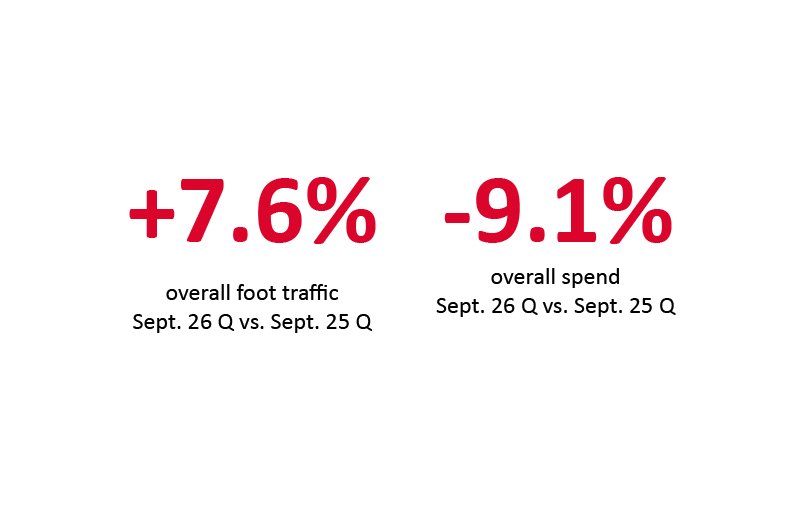
While consumer spending remained under pressure at -9.1% compared with the same quarter last year, many other indicators of city centre performance continued to improve. Foot traffic was +7.6% year on year, retail and office vacancy rates slightly declined, and major events boosted visitation and, in some cases, spend.
These results reflect a trend seen throughout 2026. While economic conditions have continued to weigh on consumer spending, people are returning to the city centre in greater numbers, businesses are showing increasing confidence, and investment activity remains strong. Together, these indicators point to a city centre that is becoming busier, more vibrant and well-positioned for future growth.
National Economic Conditions and the Impact on City Centre Spending
New Zealand's economic recovery continued during the September 2026 quarter, although business and consumer sentiment remained mixed.
ANZ Business Outlook data showed business confidence remained elevated, easing slightly from +56 in July to +52 in September. Businesses continued to signal intentions to invest, hire and pursue growth opportunities, reflecting growing confidence that economic conditions are improving despite ongoing global uncertainty.
Consumer sentiment was less positive. The ANZ-Roy Morgan Consumer Confidence Index fell from 99.3 in July to 97.6 in September, remaining below neutral levels. Cost-of-living pressures, higher fuel prices and broader economic uncertainty continued to weigh on household spending decisions, while unemployment reached 6.3% in Auckland, above the national rate of 5.7%.
Together, these indicators suggest that while businesses are increasingly looking ahead with confidence, many households remain cautious about discretionary spending.
How Did This Impact Overall Spend in the City Centre?
| Consumer Audience | Sept. 26 Q vs. Sept. 25 Q | Last 12 Months |
|---|---|---|
| HOTC overall spend | -9.1% | -7.9% |
| Central Auckland Suburbs | -8.3% | -8.3% |
| Auckland Region | +0.5% | +0.7% |
| National | +1% | +1% |
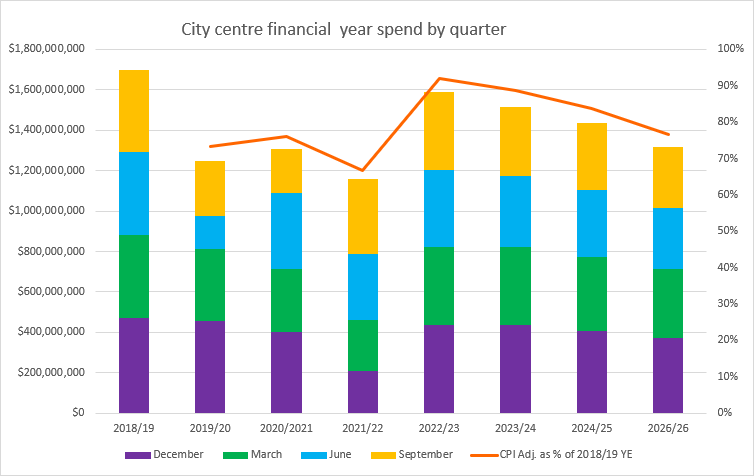
These conditions continued to influence spending in the city centre during the September 2026 quarter. Overall spend was -9.1% compared with the same quarter last year, with both domestic and international spending declining by -9.0%. Central Auckland suburbs also experienced challenging conditions, recording spend of -8.3% over the same period. In contrast, spending across the wider Auckland region and nationally increased by +0.5% and +1.0%, respectively.
Looking at the past 12 months, the picture is somewhat more encouraging. Overall spend in the city centre was -7.9%, slightly ahead of central Auckland suburbs (-8.3%). However, both remained well below the Auckland region (+0.7%) and national (+1.0%) benchmarks.
Source: Marketview. Not for Reproduction.
Foot Traffic, Events & the City Rail Link
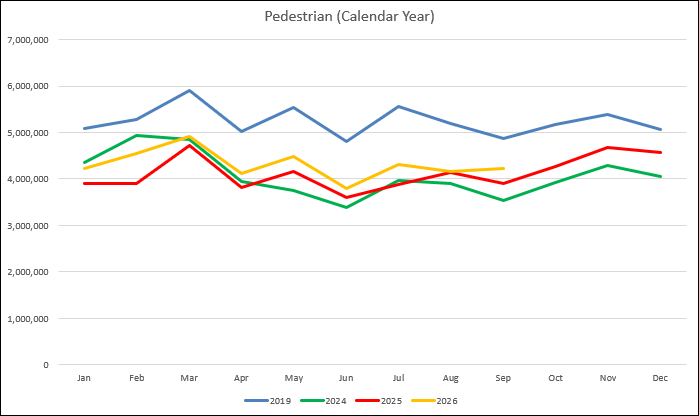
Despite softer spend, foot traffic data continued to strengthen throughout the September quarter, with pedestrian counts +7.6 % compared with the same period in 2025.
Source: HOTC Pedestrian Counts. Not for Reproduction.
Source: HOTC Pedestrian Counts. Not for Reproduction.
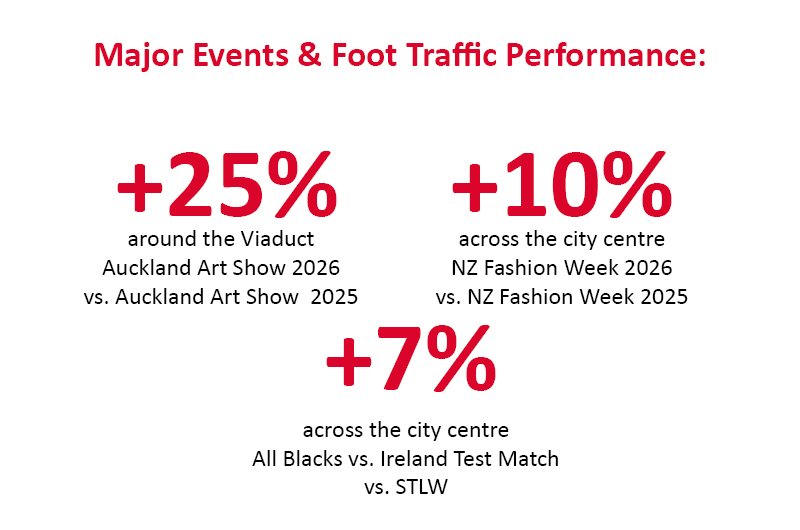
Several major events brought spikes to foot traffic throughout the quarter. New Zealand Fashion Week returned to the city centre from 17 – 21 August. With ticket sales +21.1% on the 2025 programme, foot traffic in the city centre was +10% compared to the previous year. The return of the Auckland Art Show saw foot traffic in the Viaduct +25% compared to the 2025 programme.
The All Blacks v Ireland test match brought notable boosts to both foot traffic and spend in the city centre during the September 2026 quarter. Compared with the same period in the previous week, foot traffic increased +7%, while overall spending was +36%, including hospitality spend of +41% and accommodation spend of +23%.
The opening of the City Rail Link was a transformative milestone for the city centre as well as the wider region. More than 13,000 people attended the Te Waihorotiu ‘First Look’ event ahead of its opening, underscoring the strong public interest in the project.
Source: HOTC Pedestrian Counts. Not for Reproduction.
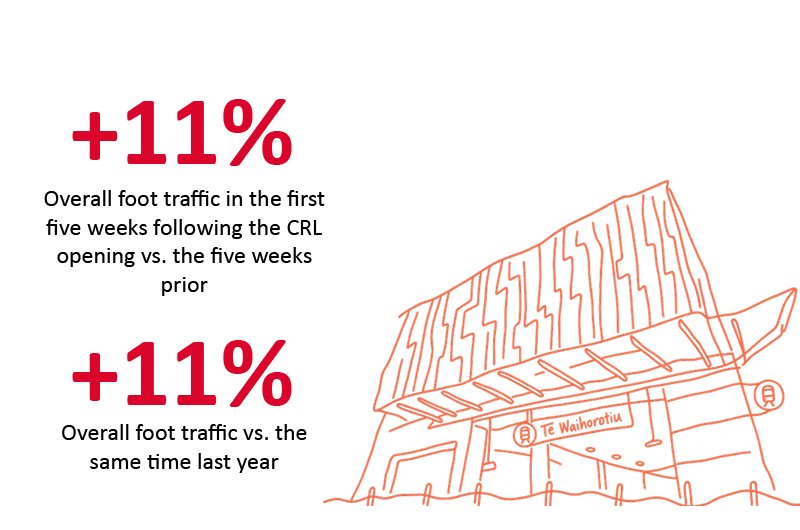
Early indicators suggest that this interest has translated into action, and that the CRL is already contributing positively to the city centre. In the five weeks following opening, pedestrian counts were +11% compared with both the five weeks preceding the launch and the same period in 2025. Anecdotally, businesses located near stations have also reported increased customer activity and new visitors.
While more time is needed to fully assess the impacts of the CRL, the early signs are encouraging. Alongside major events, improved public transport accessibility is helping to bring more people into the city centre and supporting the conditions for future economic growth.
The Divergence Between Foot Traffic and Spend in the City Centre
Sources: HOTC Pedestrian Counts & Marketview. Not for Reproduction.
One of the defining features of 2026 has been the growing gap between foot traffic and spend in the city centre, with visitation consistently outperforming consumer spending, and the September quarter continued this trend.
While this partly reflects challenging economic conditions, it also highlights that increased visitation alone does not automatically translate into stronger business performance. Foot traffic remains critical for city centre vibrancy and demonstrates the city's ongoing appeal to workers, residents, students, visitors and event attendees.
However, the greater opportunity lies in converting this activity into stronger economic outcomes by encouraging people to stay longer, engage more deeply, and spend across a wider range of hospitality, retail, cultural, entertainment and tourism experiences.
Restaurant Month Served Up Fantastic Results for Participants
Cafés and restaurants continued to be the city centre's largest spending category during the September 2026 quarter, accounting for 32% of domestic cardholder spend and 26% of international cardholder spend. Given the sector's significant contribution to overall city centre spend, its performance remains an important indicator of economic activity.
Against this backdrop, the September quarter marked the 16th year of Heart of the City's Restaurant Month. Held throughout August in the city centre, the programme featured 152 participating restaurants, more than 100 special menus and over 20 exclusive dining experiences. The strong level of participation and positive results further cemented Restaurant Month's reputation as one of New Zealand's premier culinary events, while generating significant benefits for its participants.
The 2026 programme was officially launched at Te Waihorotiu Station ahead of the opening of the City Rail Link, a venue that symbolises the transformation underway across Auckland's city centre. Ngāti Whātua Ōrākei opened the evening, followed by remarks from Heart of the City, Auckland Transport and participating chefs. The energy was electric, with attendee and regular participant Chef Michael Khuwattanse of Khu Khu noting Restaurant Month is "one of the best events of the year".
Several new partnerships and initiatives were introduced into the 2026 programme to deepen engagement across the hospitality sector and support industry development. These included How We Eat, presented by Chow Luck Club and celebrated the culture, rituals and stories behind food; Next on the Pass, developed in partnership with Auckland University of Technology to connect culinary students with leading chefs; and Commercial Bay's Fork & Fame Awards, which encouraged public participation through a voting programme.
Business Impact
Restaurant Month 2026 delivered strong outcomes for participating businesses and continued to demonstrate its value as a driver of economic activity in the city centre.
Participation increased +37% on 2025. The programme generated an estimated $3.12 million in additional hospitality spend.
First-time Restaurant Month participants recorded an average spend growth of +28.2% when comparing August 2026 with August 2025, outperforming non-participating city centre restaurants, which recorded spend of -2.1% over the same period.
Results from participating restaurants that responded to our survey further highlight the value delivered by the programme:
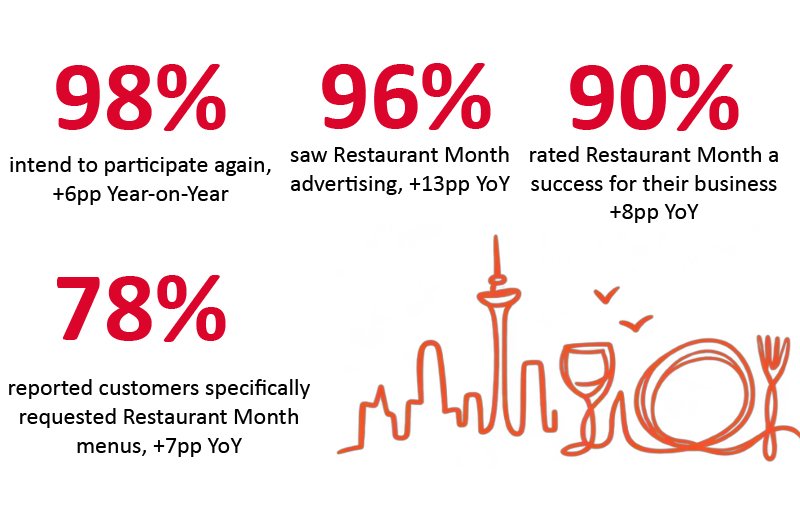
Source: HOTC Restaurant Month 2026 Post-Campaign Review for Participants. Not for Reproduction.
Feedback from survey respondents reinforced these results:
"Restaurant Month was hugely successful for our business, delivering a significant increase in covers and materially stronger performance than the previous year."
"We had an outstanding revenue month, with a large number of first-time diners coming through as well."
“There a was a massive response”
“Restaurant Month is always a great revenue generating moment in what would otherwise be a quiet month”
“We look forward to the lift in sales August brings with Restaurant Month. It’s now very well established and diners across Auckland seek out chances to experience it. We notice new diners who probably wouldn’t normally dine with us specifically coming in for RM which is great.”
Demand for Restaurant Month events also continued to grow. Capacity was +35% compared to 2025, and 95% of all available tickets sold, +10 percentage points year-on-year. Among participating restaurants that hosted an event and responded to the post-event survey, 100% reported that their event was successful for their business, +13 percentage points on 2025.
Contribution to City Centre Vitality
Restaurant Month continues to help shape positive perceptions of our city centre. Post-campaign research found 69% of Aucklanders and 82% of Heart of the City subscribers believe initiatives like it contribute to a vibrant and successful city centre.
Just as importantly, Restaurant Month is increasingly turning interest into action. The share of Aucklanders motivated to visit the city centre rose from 40% in 2025 to 47% in 2026.
As Heart of the City’s signature hospitality event, Restaurant Month continues to showcase the best of Auckland’s dining scene while delivering meaningful economic benefits for participating businesses and the wider city centre economy. We’re already back in the kitchen, planning Restaurant Month 2027.
Leasing News
Sources: Colliers, H2 2026 Auckland CBD Office & Retail Reports.
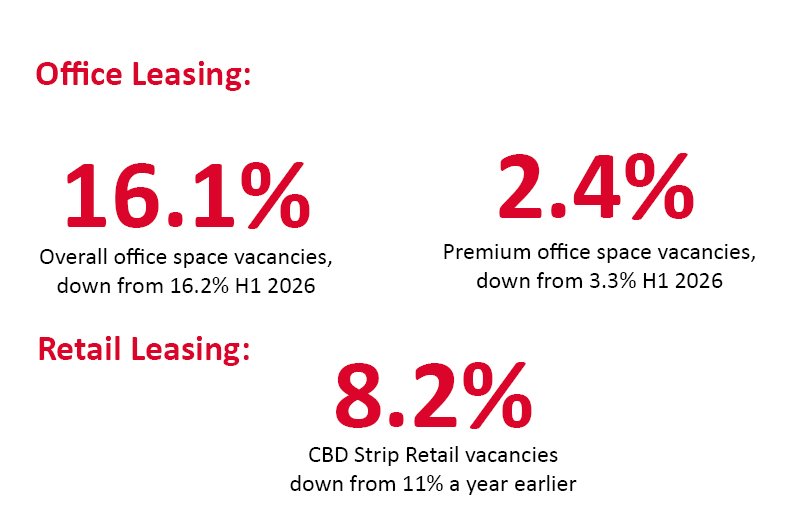
The leasing market continued to strengthen during the period as businesses increasingly backed the city centre as a place to invest. Retail vacancy continued to decline, while demand for premium office space remained strong, reflecting an ongoing flight-to-quality trend. Together, these indicators point to growing business confidence and continued investment in a city centre presence
Office Vacancy Rates
According to Colliers Auckland CBD Office data, the market remained broadly stable through the reporting period, with overall vacancy easing marginally from 16.2% to 16.1%. Performance continued to vary significantly across asset classes.
Premium office space remained the strongest performing segment, with vacancy falling from 3.3% to 2.4%, reflecting sustained demand for high-quality workplaces. Prime-grade vacancy remained steady at 8.6%, while secondary vacancy remained elevated at 24.3% as occupiers continued to favour newer buildings offering stronger amenity, sustainability and transport connectivity. These results continue to reflect the ongoing flight-to-quality trend.
Looking ahead, the City Rail Link is expected to help reduce office vacancy rates, particularly in Midtown.
Retail Vacancy Rates
The city centre retail market continued its recovery in the second half of 2026. Colliers reported CBD strip vacancy fell to 8.2%, its lowest level since 2020 and a significant improvement from 11.0% a year earlier.
The reduction in vacancy reflects improving occupancy along key retail corridors, including Queen Street, and continued leasing activity across the city centre. The result is a positive indicator of growing business confidence and reinforces the attractiveness of the city centre as a retail destination. Colliers reported strong demand around lower Queen Street and the waterfront, with rising foot traffic expected to continue supporting retail leasing conditions.
Business News
There were several moments throughout the quarter that showcased growing confidence in the city centre and reinforced its reputation as a dining, retail and investment destination.
Heart of the City restaurants were well represented at the first-ever Michelin Guide Awards in New Zealand. Ahi was awarded one Michelin Star, while BODA, Bistro Saine, GOAT and Milenta received Bib Gourmand recognition. A further 16 city centre restaurants were recognised as Michelin Selected, spotlighting our restaurants on the international stage.
Queen Street welcomed some major retailers during the September quarter. The opening of Noel Leeming’s experience-led flagship store had hundreds of excited shoppers queuing down the street. The opening of Faradays transformed the historic Milne & Choyce building at 131 Queen Street into a premium retail destination spanning 3,000 square metres and more than 220 brands.
Both openings reflected growing confidence in Queen Street and the wider city centre. With the City Rail Link nearby, there’s a real sense of momentum building.
The September 2026 quarter will be remembered as the quarter Auckland city centre entered a new chapter. The opening of the City Rail Link has reshaped access to the city centre, while strong event performance, growing foot traffic, declining vacancy rates and continued business investment all point to a city centre with growing momentum.
While economic pressures continue to constrain consumer spending, the city centre is attracting more people, more businesses and more investment than it was a year ago. The task now is to convert that growing activity into stronger economic outcomes for businesses.
The foundations are in place. With improved connectivity, renewed confidence and a growing number of people choosing to spend time in the city centre, it's well-positioned to capitalise on the opportunities ahead.