Quarterly Results - June 2026
Throughout the reporting period, there was demonstrable progress in the city centre’s recovery. Foot traffic increased year-on-year, major cultural, entertainment and business events attracted thousands of visitors, and significant private-sector investment underscored confidence in the city's future. However, despite growing activity and visitation, spending remained subdued. The June quarter results reinforce the importance of focusing on factors that can be influenced. This includes attracting more people, encouraging longer stays, and enhancing the overall appeal and experience of the city centre.
Take a closer look.
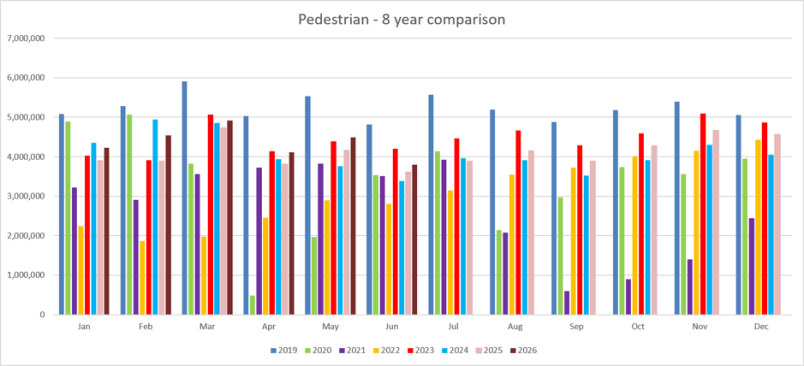
Foot traffic continued to grow year-on-year
More people out and about was one of the most tangible indicators of vibrancy in the June 2026 quarter, with foot traffic +7% compared to the June 2025 quarter.
Source: HOTC Pedestrian Counts, Not for Reproduction.
Culture, Comedy and Conferences drive city centre activity
The city centre played host to a diverse range of arts, entertainment and business events throughout May. Major festivals, a sold-out concert and New Zealand’s largest tourism trade event attracted people from across the country and around the world into the heart of the city.
Source: HOTC Pedestrian Counts, Not for Reproduction.
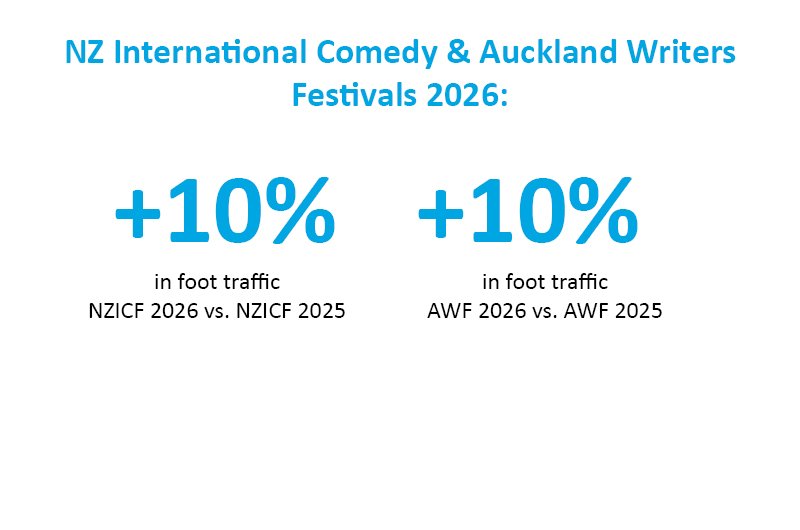
May also saw the city centre play a key role in hosting both the New Zealand International Comedy Festival (NZICF) and Auckland Writers Festival (AWF).
Local and international comedians entertained audiences throughout the month of May. Halfway through the programme, Interim Festival Director Gemma Gracewood said:
“We’re seeing stronger early engagement than we’ve had since before Covid, with standout demand across ticket sales and box office… “It’s also fantastic to see smaller venues selling out and a real city-wide buzz, with audiences staying out later and venues at capacity in Auckland and Wellington.”
Our foot traffic data reflected that “buzz”, with overall city centre foot traffic +10% and Aotea Square, which is near several venues, +7% compared with the 2025 festival.
Heart of the City was proud to be a sponsor of the 2026 Auckland Writers Festival. This year’s programme broke all ticket sales records to become the largest event in its 27-year history. Ticket sales were +15% on 2025, and 6,000 schoolchildren attended dedicated festival events. This strong engagement was reflected in city centre activity, with foot traffic +10% compared with AWF 2025. Aotea Square, where much of the festival programme was hosted, recorded a similar increase, with foot traffic +11%.
Source: HOTC Pedestrian Counts, Marketview. Not for Reproduction.
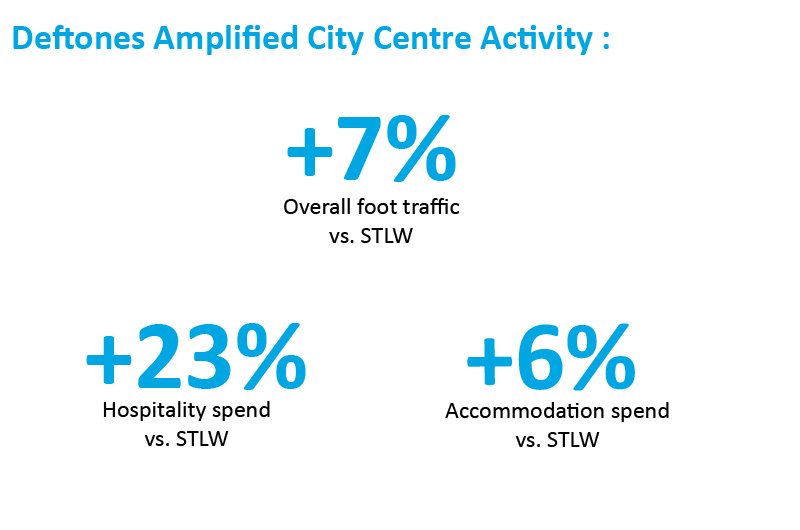
Alt-rock legends Deftones' one-off Spark Arena show in May re-emphasised the benefit of major concerts to the city centre. Performing their first New Zealand show in more than a decade, the band played to a sold-out crowd of 12,500. According to Tātaki Auckland Unlimited, 45% of attendees travelled from outside Auckland, generating 8,400 visitor nights, a $1.12 million boost to Auckland's GDP and $1.97 million in visitor spending. Those visitor and spending impacts were mirrored in our city centre data, with foot traffic +7%, hospitality spend +23% and accommodation spend +6% compared with the previous Wednesday.
The New Zealand International Convention Centre hosted TRENZ, the biggest tourism trade event on New Zealand’s calendar. TRENZ brought together 350 international travel buyers, more than 35 global media representatives and 880 New Zealand tourism operators. Beyond showcasing the very best of the Auckland region, TRENZ delivered real impact, with Tātaki expecting delegates to contribute $3 million into the regional economy between 18 – 22 May.
Collectively, these events further strengthened the city centre's reputation as a destination for world-class experiences across arts, culture, entertainment and business, while also creating opportunities for economic growth.
Spending Remains Under Pressure Despite Increased Activity
Source: Marketview. Not for Reproduction.
| Consumer Audience | Jun. 26 Q vs. Jun. 25 Q | Last 12 months |
|---|---|---|
| HOTC Overall Spend | -9% | -7% |
| Competitors (Central Auckland) | -5% | -5% |
| Auckland Region | +2% | +0.5% |
| National | +3% | +0.8% |
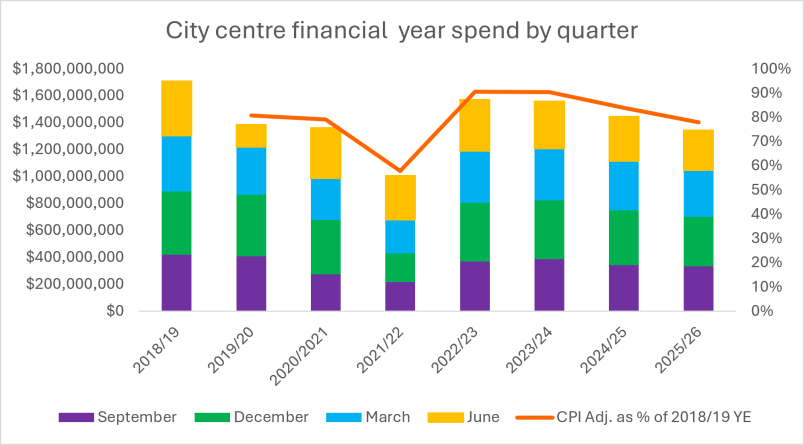
While the city centre was busier in the June 2026 quarter, spend remained subdued.
As in the previous quarter, spend in the city centre continued to be impacted by ongoing cost-of-living pressures, global uncertainty and higher unemployment. Auckland's unemployment rate rose to 6.4% in the year to June 2026, up from 5.8% the previous year and above the national rate of 5.6%, putting further pressure on household budgets.
Looking at national external factors, confidence was volatile throughout the quarter. Following the outbreak of conflict in the Middle East, ANZ Business Outlook data showed confidence falling from 32.5 in March to -10.6 in April, before rebounding to +10 in May and +37 in June. ANZ noted that much of June's improvement occurred before the late-month decline in oil prices, suggesting businesses were becoming more optimistic despite ongoing economic challenges.
Consumer confidence followed a similar trajectory but remained notably weaker. The ANZ-Roy Morgan Consumer Confidence Index dropped from 91.3 in March to 80.3 in April, its lowest level in around three years, before recovering to 86.5 in May and holding steady in June. Despite this improvement, confidence remained 21 points below its January peak, indicating consumers were still cautious even as business sentiment strengthened.
This caution is reflected in JLL's New Zealand Market Dynamics Q2 2026 report, which notes that "the near-term outlook for the broader [retail] sector remains challenging. Weak consumer confidence, driven by persistent high living costs, is dampening discretionary spending. This is expected to create a cautious retail environment throughout the remainder of 2026."
The impact that this wider backdrop had on spend during the reporting period was patchy.
Both the city centre and Central Auckland reported decreases in spend compared to the June 2025 quarter, which was out of step with stronger regional and national performances.
Total spend for the city centre was -9% vs the June 2025 quarter, compared to -5% for Central Auckland competitors. This is a narrower gap from the March 2026 quarter, where spend here was -9% compared to -1% among competitors. By comparison, Auckland region and national spend was up +2% and +3% respectively over the same period.
Over the 12 months to June 2026, overall spend in the city centre was -7%, more aligned with our Central Auckland competitors, who recorded overall spend -5% over the same period. Comparatively, there were modest upticks regionally and nationally over the last 12 months, +0.5% and +0.8% respectively.
For the city centre, the data suggests that, in addition to the cyclical factors affecting spending nationwide, such as cost-of-living pressures, global uncertainty and rising unemployment, it is also facing unique structural challenges. These are longer-term changes that can reshape spend patterns over time.
The Market Economics assessment of the city centre for the 2025 calendar year highlighted several structural shifts contributing to lower spending in the city centre. These included increased online shopping, reduced foot traffic due to hybrid work, and changing travel patterns.
Taken together, these results suggest that while the city centre continues to face both economic headwinds and longer-term shifts in consumer behaviour, the latest quarter shows encouraging signs. Spending was more closely aligned with Central Auckland, and the gap with competitors narrowed. While recovery remains a work in progress, the June quarter provides encouraging signs that the city centre is moving in the right direction.
Source: Marketview, Not for Reproduction.
International Visitors Continue to Support Spending Performance
The latest results from Tātaki Auckland Unlimited show international visitor arrivals to the region were +4.4% year-on-year in the 12 months to May 2026. In the city centre, international spend returned to typical seasonal levels during the latest quarter. However, the pattern of spending mirrored that seen here a year earlier, with international spending proving more resilient than domestic spending.
International visitors accounted for 20% of total city centre spending during the June 2026 quarter and were the only segment to record growth in spend per cardholder, +1% on the previous quarter. Compared with June 2025, international spend was +1%, compared to domestic spend -12% over the same period.
Confidence in the city centre's future remains strong despite challenges
Throughout the quarter, businesses, developers and investors continued to demonstrate their confidence in the long-term future of the city centre.
New businesses continued to open in the city centre, including The Meeting Room, Remy's Deli and Bravo in Cracker Bay.
Britomart Group announced the development of Britomart Central to replace The Pavilions. The completed building will feature 20,000 sqm of premium office, retail and hospitality space. Britomart Group said on their LinkedIn page: “It’s a vote of confidence in the future of downtown waterfront Auckland….the project responds to continued demand for high-quality workplaces in well-connected locations, as businesses place greater value on environments that help them attract and retain people and bring teams together in person.”
In their New Zealand Research Report for August, Colliers highlighted continued interest by international investors in New Zealand’s commercial property market, demonstrated by the conditional sale of a 50% stake in Precinct Properties' PwC Tower for US$349 million. Colliers observed: “Heightened global uncertainty is encouraging offshore investors to seek out markets that offer stable returns, and New Zealand’s commercial property market is offering this.”
Flight to quality continues to drive retail and office leasing results
Source: JLL, New Zealand’s Market Dynamics, Q2 2026
Office Leasing
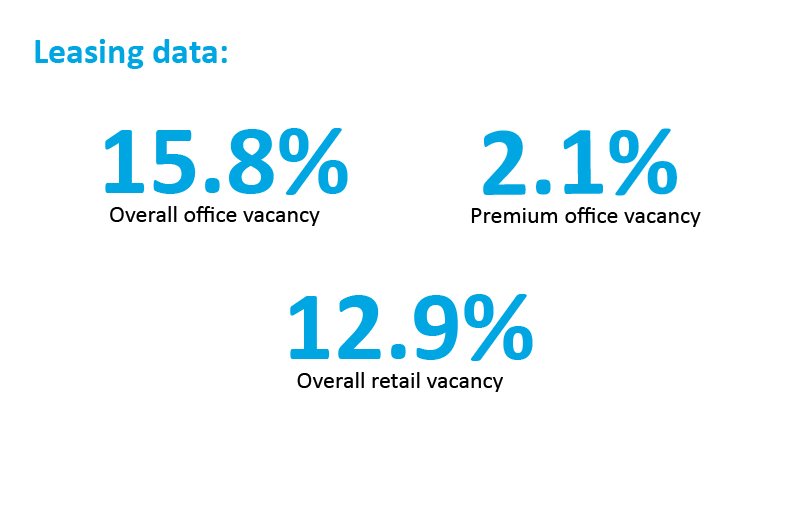
JLL reports that overall office vacancy in the city centre is sitting at 15.8%, but premium office vacancy is 2.1%, which JLL describes as “exceptionally low”… Despite a soft economy, the Auckland CBD office market is showing renewed momentum from strategic investors and occupiers. Demand is driven by a ‘flight to quality,’ as tenants prioritise premium, sustainable, and wellness-focused environments that meet modern workplace expectations". Prime office space (defined as Premium and A-grade buildings) now accounts for 52% of city centre office stock, up from around one-third a decade ago, reflecting changing occupier preferences.
To meet demand, developers are refurbishing existing city centre buildings. In the June quarter, CBRE highlighted the transformation of the historic QBE Centre at 125 Queen Street, where occupancy increased from around 40% to 80%, including securing Kernel’s headquarters. CBRE says the project illustrates how thoughtfully refurbished heritage buildings can revitalise city streets by combining modern workplaces with active retail and hospitality frontages. The renewed street-level activity is also helping to reactivate nearby Swanson Street by boosting foot traffic and vibrancy.
Retail Leasing
Results from the retail sector also highlight a strong preference for quality. JLL reported that retail vacancy fell to 12.9%, with demand the strongest in prime locations with high pedestrian activity and strong transport connectivity.
The report also notes that most new retail space is being added through mixed-use developments rather than standalone retail projects. A recent example of this is Josh Emett’s announcement of a third eatery in the city centre – Lottie’s in the yet-to-be-opened Faradays. In an interview with Newstalk ZB, Josh said: “We love the CBD, we’re very invested in the area”. Both Faradays and Lottie’s are notable ticks of confidence in the city centre’s future.
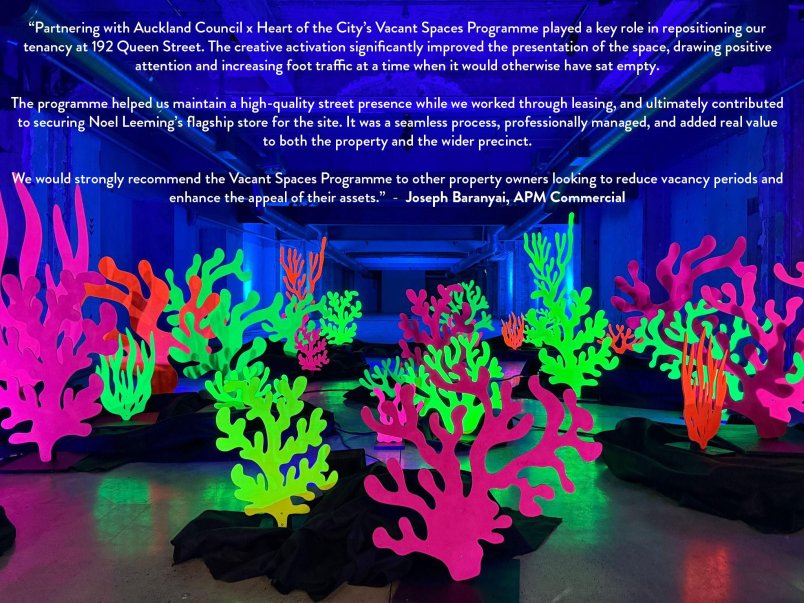
Creative activations, such as our Vacant Spaces initiative continue to support retail leasing efforts. A temporary artwork in the window of 192 Queen Street played a role in the leasing of the site to Noel Leeming’s flagship store in the June Quarter. We also interviewed artist Trish Campbell and part property owner/manager Olly Gunman about their experience working together on 2 – 4 High Street. Trish’s neon installation shifted the energy of the space, and it was leased within months. It's a great reminder that even between tenants, a space can still work hard for the street.
Business News
In June, Precinct Property marked ten years since Auckland’s Downtown Shopping Centre began its transformation into Commercial Bay. According to an article in Stuff marking the occasion, Commercial Bay now hosts more than 10,000 workers and attracts around 13 million visitors annually, while continuing to record strong retail and hospitality sales growth. The success of Commercial Bay demonstrates the value of sustained investment, strong partnerships and a long-term vision for the city centre.
There was strong recognition for city centre hospitality at the 2026 Lewisham Awards. Six city centre businesses took out awards, with another eight named as finalists. Among those celebrated:
• Gilt Brasserie – Outstanding Wine Experience, Outstanding Bartender, Outstanding Chef
• Panacea – Outstanding Front of House + Hospitality Hero
• d.o.s.e – Outstanding Café
• Truth or Dare Bar – Outstanding Cocktail Experience
• Ground Wine Bar – Outstanding New Establishment
• Amano – Emerging Hospitality Talent
From chefs and bartenders to front-of-house teams and new establishments, it was great to see the talent behind our hospitality sector recognised. Hospitality plays a vital role in shaping the energy and appeal of our city centre, creating places people want to visit, connect and spend time. Looking ahead, we’re excited to report on our results for Restaurant Month, in our September 2026 quarterly results.